Walking Duluth
A wonderful town that reminds you, place still matters.
I don't know exactly when I became unnaturally interested in Duluth. Perhaps it was as a child in Florida, dreaming of winter wonderlands, when I spotted it on the map—up there in the far north, nestled snugly at the westernmost vertex of Lake Superior.
All of the far Northern cities fascinated me. I was living in what I imagined their residents thought of as a tropical paradise — surrounded by palm trees, orange groves, and rivers out of Tarzan — and all I wanted was a little of what they had. To spend my afternoons frolicking in the snow, or ice fishing on a lake that froze, a thing that sounded too crazy to be true.
We had a single snow storm, in the winter of ‘77, that slicked the roads enough to turn them white, but not enough to close the schools, so when we did get home, we ran around frantically collecting the patches of snow that hadn’t melted, the bits huddled in the shadows of trees and shrubs, and crafted a two-foot snowman, a scrappy leaf and ice abomination that we held proudly before us, beaming for a square photo1, in our thin jackets from the Army Navy store, and socks on our hands, thinking we were arctic explorers.
Florida then was just beginning to swell with the Northerners who thought differently from me, and my county (Pasco) was getting the decidedly downscale ones. We were not getting the retired lawyers, bankers, and engineers—that was for the southern coast. We were too far interior for that, too redneck, too white trash and so we got the UAW member from Michigan taking a buyout, truck drivers from Wisconsin sick of all them regulations, and women seeking a better life for her kids away from bad Minnesota men. People who saw being able to walk out of a trailer in shorts, anytime of the year, and never again having to shovel a driveway, and of having a “frickin’ orange tree, can you believe that, a real frickin’ orange tree” in your yard, as the true American dream.
I did eventually migrate North, working my way up the coast from Baltimore, to New York City, to where I am now, in the Hudson Valley, but I never found any of them to be the winter wonderland I’d dreamed of as a kid. Sure, they were all colder, had snowstorms, some even had pro hockey teams2 that people cared about, but winter was still something to be endured, not embraced.
There was something else about the places I passed through—they all had active ports and when I started reading more about the shipping in each location, I kept noticing Duluth popping up, which only reinforced my interest.
Duluth is the westernmost terminus of the extensive, and historically important, Great Lakes shipping network that brings iron ore from Minnesota, grains from the Dakotas, lumber from Wisconsin, through a series of locks, all the way to New York City, Baltimore, and points further East, and vice versa, but with different loads.
I’m an unabashed logistics nerd and one of my goals is to remind readers that while the U.S. might have pivoted in the last few decades to being a service-based economy, offshoring a chunk of our manufacturing (with large social and political ramifications), we still make a great deal of stuff, including steel.
Spending the last month frozen in South Chicago was the perfect window to see that, because the Rust Belt, despite its moniker of decay, is still very much alive and kicking, and so is the Great Lakes shipping network.
During my aborted first attempt at flying to Duluth, when I was stuck for four hours on the tarmac with a planeload of Duluthians, I was reminded of another American fallacy—the idea that we are transient people, with no sense of place. That is certainly true of me, and most readers of this, and of the Northerners who filled my Florida in the ‘70s, but we are a minority. The majority of Americans still live within thirty miles of where they were born.
That certainly seemed to be the case of everyone on the flight, including Travis, who had done thirty years in the Air Force, saw the world, and decided to retire in his hometown of Duluth. Not despite the then current minus ten degrees, but because of it. As he said, “All my military friends call me from the beach and say, ‘How’s the weather up there?’ laughing and I send them this (shows video of tossing a pot of water off his porch, the spray freezing before hitting the ground) and I say, ‘Great. Going hunting today, then sledding with the kids later, couldn’t be better. I wouldn’t live anywhere else.’”
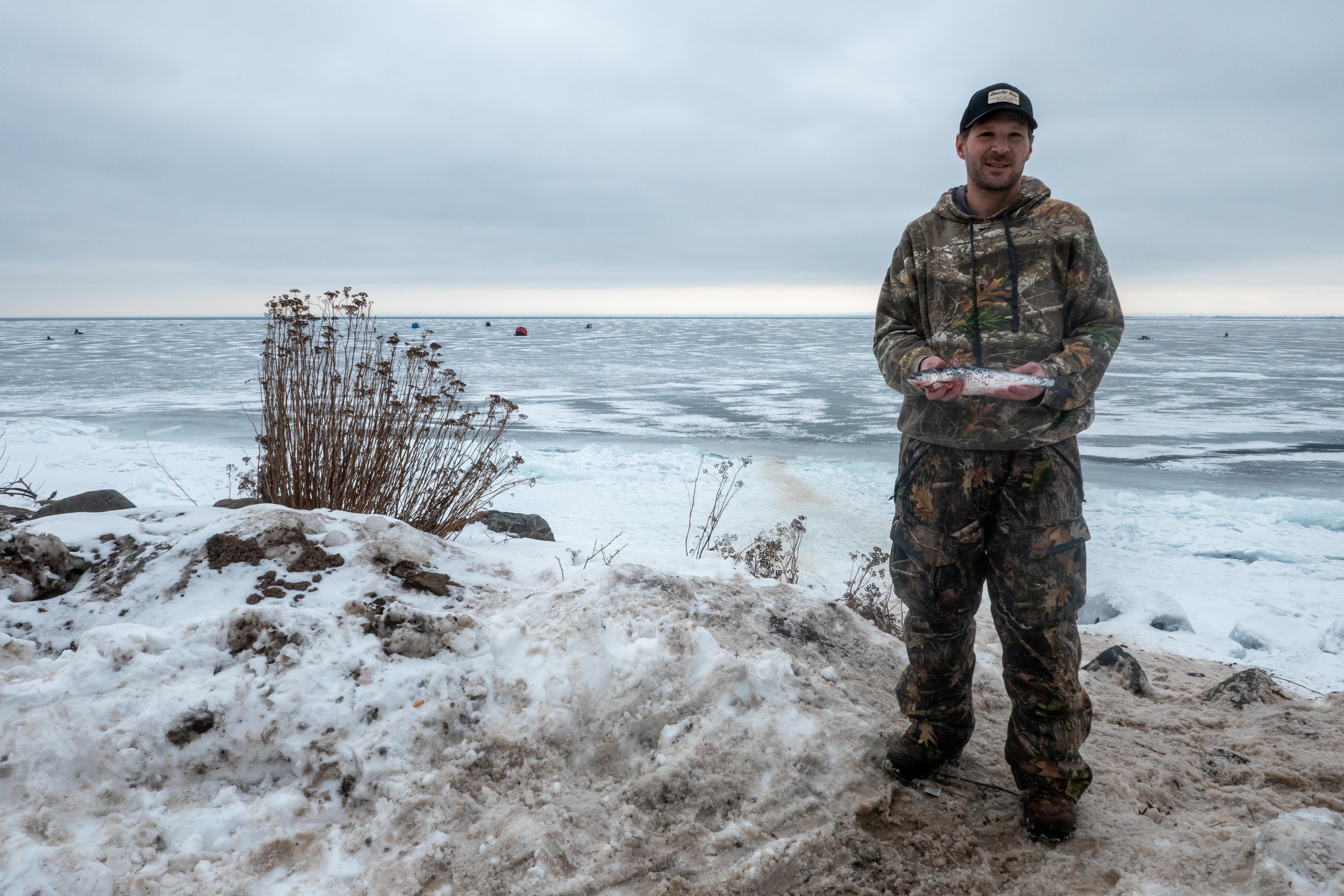
When I finally did make it five days later, I heard some version of that “I wouldn’t live anywhere else” over and over and over, including from the man in the cover photo, just off a morning on the ice, proudly holding up one of his five (catch limit) fish.


He wasn’t alone on the ice by any means. His truck was one of about forty lined up approaching the lake, all with beds jammed with heavy equipment, all plastered with pro-fishing, pro-hunting, and pro-lascivious women bumper stickers. When I asked him if I could go out to one of the huts and watch, he said, sure, but pointed out a “long fissure in the ice that’s wearing on being too thin for walking” that I might want to avoid, a fissure that I couldn’t see no matter how much pointing he did, which immediately killed my interest. Did he or any of the other guys out there worry about falling through? No. The real issue was not paying attention and your chunk of ice breaking off and floating away, which had happened a few years back, but then the Coast Guard came and rescued them and told them that was the last time they would do that and if it happened again they were on their own, which is why we all are a little more aware of the shoreline now.
When I asked him his backstory (born and raised in Duluth, worked at the hospital) and if he thought of moving, he looked at me like I was a crazy person, asking a crazy question. Move? What do you mean? Why? The weather? You mean to someplace where I couldn’t go out on the ice and catch fish? Where I couldn’t go hunting in the afternoon? Where I couldn’t have dinner with my parents at night? Where I couldn’t hang with my buddies at Roscoe’s?
Place still matters to Americans, and few places place as hard as Duluth does.
I saw that in the bar I spent each evening in, Roscoe’s, where I met a reader (Hi Rand, and thanks for the beers) who was back in town to visit his parents and where we kept being interrupted by friends from his childhood, me sipping my beer quietly, as they cycled through updates of people they both knew, which by the end of the night seemed to exhaust the entirety of Duluth.


I'd gotten a quick introduction to Duluth and Roscoe's special charms the night before. A group of women burst into the bar with thick accents too polite for their actions, dressed far too scantily for the zero degrees, did body shots with some bemused orbiting men, and then after two began to argue—again in an accent too polite for the content—they went outside to fight. Everyone else in the bar ignored them, focusing instead on the Wild match on the TV, despite the cartoonish wrestling going on only yards away impeccably framed by the front window, because that is what they do apparently. When I left a half hour later, I passed the two women in a doorway, hugging, one sobbing on the shoulder of the other, makeup smeared and dripping, both with their hair in a tussled mess, each still oblivious to the subzero temperatures, although a friend had at some point brought thin coats for both to drape over them.
I saw Duluth’s more focused, grounded, and warm spirit in the curling club the next evening, where a crowd was gathered to celebrate (now silver medalist) Corey and Korey heading off to the Winter Olympics, including Senator Amy Klobuchar down for an afternoon photo op, and for Friday night open club curling.
I hadn’t intended to go to the curling club, which I’d passed in the skywalk3 on my way to the arena to see some college hockey. University of Minnesota Duluth had a home game, and what better way to spend a Friday night, so I went up to the ticket booth and asked for a single ticket and the woman looked at me like I was the biggest idiot ever, the guy who just fell off the potato truck and hit his head, and said, “There are no single tickets left, UND are in town!” and yeah, what was I thinking, UND are in town…


A few hours later, as I sat in the curling club immersed in a sea of large people in green Sioux jerseys, I fully understood what a fool I’d been, and that UND versus UMD is indeed a big big big thing. It seemed all of North Dakota had made the four-hour drive, and now half of them were pre-gaming at the curling club, and the other half were staying at my now sold-out hotel.
I'd primarily come to Duluth to see the port, which, given that it was winter, was shuttered and frozen tight—but that didn't matter to me. Like any lover of art, I was content to simply bask in the aura of it all, to walk across the ice-covered aerial lift bridge, gaze up into the heavy chains, and down into the icy cold entry channel and imagine all the barges of iron ore that passed through it, mined a hundred miles away in the Mesabi iron range, and bound for the steel mills of Gary, or Burns Harbor, or Buffalo, or far across the Atlantic.
Content to look across the frozen ice, which moaned in low tremors, at the grain silos in Superior, hopefully filled to the brim with the harvests of the Dakotas.
Happy knowing I was in the busiest freshwater port in the country. Happy in my mental movie of what it was like when all the ice was melted. Hovering above it all like a drone, following a single taconite pellet as it is mined outside Hibbing, forged into a marble-sized ball, shipped by train into Rice’s Point a mile away, stored, then loaded onto a thousand-foot freighter which weaves its way out into Superior under the bridge I was standing on, through the Soo Locks at Sault Ste. Marie, down through the lower lakes to the steel mills of Northern Indiana, where I was only two days before.
A nineteenth-century system essential to building America, still running, moving millions of tons annually, now mostly invisible to Americans who think we don’t make anything anymore, a common misconception, a symptom of our past successes. We’ve gotten so rich from our excellence at logistics that we’ve forgotten how excellent at logistics we are.


Although I’d only been in Duluth two days, whenever I spotted the bridge, a beautiful work of art, I already felt like a local, because I kept thinking of the story I’d been told on my flight into town of how they couldn’t manage to find anyone to fill the job of working the lift for more than a few months. It attracted a lot of interest, presumably from people like me who are overly romantic about heavy industry, but everyone quit after a few months as the banal reality of being confined to a small frigid room pushing a button sets in.
America still makes things, lots of things, and Duluth is one of the most crucial, and overlooked, nodes in all of that4, which when wrapped in a warm blanket of Roscoe’s, the curling club, and ice fishing makes it a wonderful city.
Duluth is special and unique, and a perfect counter to people who argue (including me at times) that the U.S. is becoming all the same, flattened by commercialism and globalism into a uniform glob, and that unless you live in a big destination city, life is a constant depressing struggle.
The U.S. contains multitudes, and our regional differences are vast, and most people live fulfilling lives, without a lot of cinematic drama, but with a lot of quiet dignity, in the town where they were born.
Being reminded of that isn’t why I went to Duluth, but that’s the great thing about traveling, especially when you are willing to go to places when you are not supposed to go (in February) — you never know what you will learn, but you will certainly learn something.
Aside from the big lessons, I also understood I was correct as a child to be unnaturally interested in Duluth. I’d finally found my winter wonderland, which I’d “known about” all along, but only took fifty years to realize.
So, go to Duluth, because it is a fantastic underappreciated town, and go in the winter, but make sure to buy your UMD tickets well ahead of time. Especially if those damned Sioux are in town.
I am home again, and need some emergency dental work, so I won’t be able to travel until March. So I will do my best to keep writing, but the next two pieces may be less travel-y than usual.
Here is my tentative schedule after that. As usual, happy to meet up with anyone who crosses paths!
Seoul: March 3rd -9th
Qingdao (China): 9th to 13th
Taipei and Taitung: 14th to 22nd
Okinawa: 22nd to 30th
Yangon (Burma): 1st to 5th ?
Seoul again: 5th - ?
Until next week. Be kind!
I haven't been able to locate a copy of this photo, which was my favorite from childhood, but the image in my mind cannot be erased. Looking at it, in retrospect, it was amazing just how scrappy childhoods of the 70s were. We dressed like ragamuffins, without a single thought given to style.
Still find it amusing that whenever I now check in on the NHL, the Tampa Bay Lightning are a powerhouse, and Canadian teams, not so much. That they also have a great fan base means the marketing department finally figured out just how many Northerners now live in the Tampa Bay Area, either full time or part time.
Like many frigid towns, you can navigate most of central Duluth via pedestrian malls and walkways without putting on a winter jacket.
I asked my computer for a list of Duluth’s manufacturing, and this is what I got.
Cirrus Aircraft (small general aviation aircraft, SR20/SR22 models)
Verso Corporation (paper mill - coated paper products)
Lake Superior Paper Industries/Sappi (specialty paper, packaging materials)
US Steel - Keetac/Minntac (iron ore processing, taconite pellets - nearby)
Cliffs Natural Resources (iron ore mining/processing - Iron Range region)
AAR Cargo (aircraft maintenance, repair, overhaul)
Halvor Lines (truck/trailer manufacturing, repair)
Labovitz Enterprises/Maurices (clothing distribution, some manufacturing)
Northern Contours (custom metal fabrication)
Lake Superior Fabrication (structural steel fabrication)
Zenith Tech (precision machining, aerospace components)
LHB Engineering (not manufacturing but major employer - engineering/design)
BNSF Railway (freight rail operations, port shipping)
CP Rail/Canadian National (freight rail)


This piece had me reminiscing hard about my childhood and adolescence growing up in Minnesota winters where nobody complained about the weather… ever! I remember when I was in the 10th grade, my grandpa came to visit from Italy and had a similar fascination to yours with Duluth, so I accompanied him on the greyhound north and we spent two days admiring the vastness of Superior. My grandpa kept muttering (in Italian) “what melancholy.” Coincidentally my other grandfather had sailed on a merchant ship all the way from Italy, through the lakes, to Duluth in the mid-fifties and still tells the story if prompted to this day.
Thanks, Chris, for allowing me to relive those memories through your update about Duluth in 2026. All the best.
1. Oh, very well then, if you insist:
https://en.wikisource.org/wiki/The_Untold_Delights_of_Duluth
2. I heard a european women talking on the phone from the Dakotas with a friend back in europe (she didn't know I understood) - "I have discovered The Land Of The Real Men! If you want a Real Man, come here and take your pick!"