
Two Interviews: An Author and a Painter
A book about baseball, and community, and a man who paints Japan

I walk because it allows you to see a place in a way that you can’t when zooming through it, treating it as a spectacle to be commodified1. You get to know it, and the people in it, at a thick level, warts and all. You see things that others, including sometimes locals, miss, because of a perspective that comes with being an outsider, but one moving cautiously and slowly.
The two people I’m interviewing here also do that, but in different ways, and in different places. Will Bardenwerper spent considerable time in a small town, Batavia, New York, documenting the impact of Major League Baseball’s decision to “streamline” their minor leagues, and what they tried to do about it. Kendric Tonn has now made three trips to Japan, spending months painting images from it, often of the unremarkable, that he renders remarkable.
Both are outsiders, who respect the communities they document, because they practice what I call Thick Travel — spending enough time somewhere to be confronted with the mundane, which is where most of life resides, including the excellent2.
Will Bardenwerper, author of Homestand
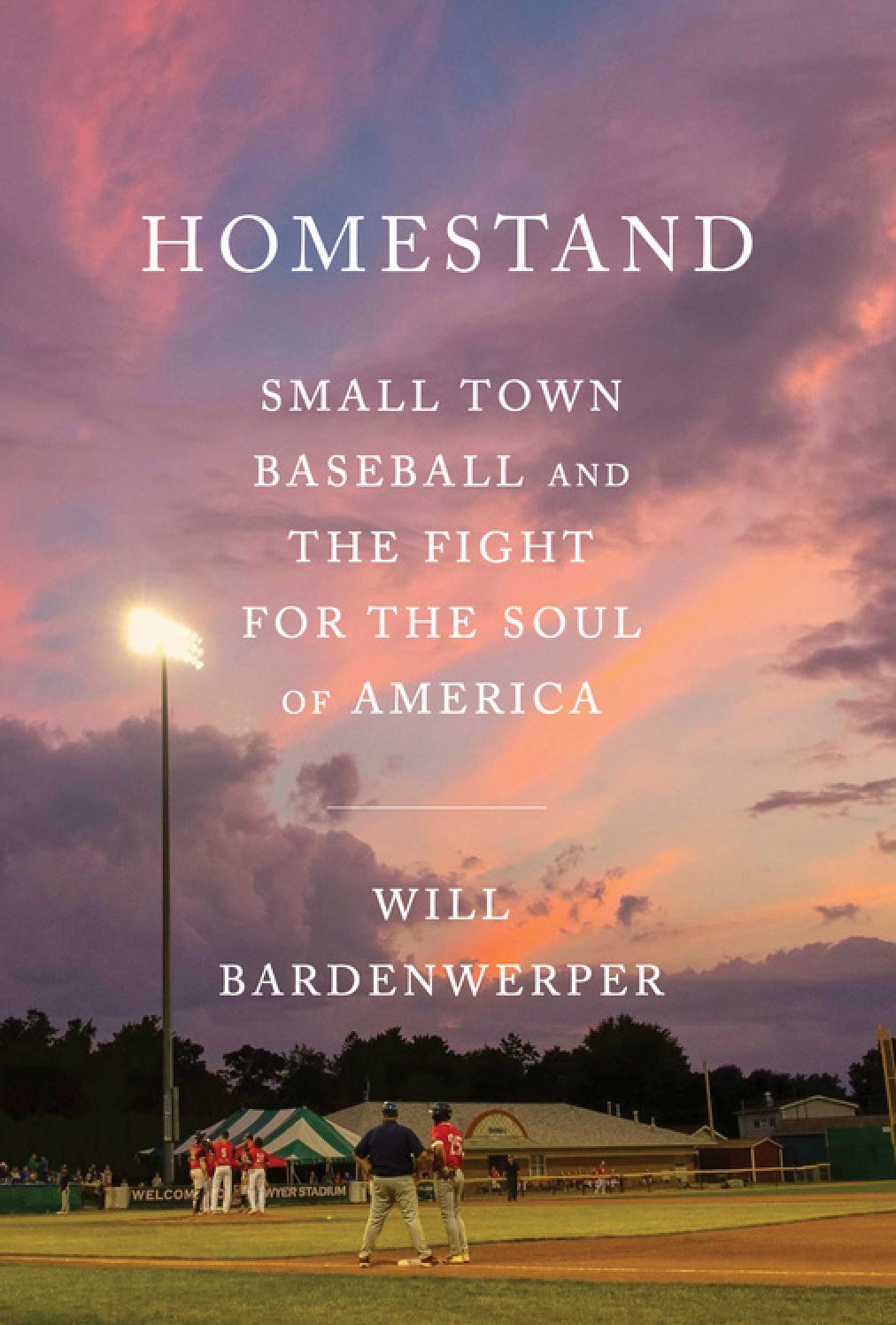
I met Will at a conference of writers, academics, and outcasts of both, who worry about the loss of community in the U.S., and through that we became friendly, and when he published his latest book, Homestand: Small Town Baseball and the Fight for the Soul of America, I was happy to provide a blurb, something I get asked often, but rarely do, because I respect that he actually goes out and talks to people, not to poll them and then leave, but to listen to them for an extended period, and the issue he addresses, of a small town (Batavia NY) trying to preserve its heritage, is one I’ve long been interested in. Also, I love baseball.
As I wrote then, his book is “A deep and emphatic look at communities, and a very American game, trying to cope with and overcome powerful external forces that only see profits and have forgotten the transcendent in life, and in baseball.”
I’ve been remiss not to give him, or the book, a big spotlight, and below is my interview with him to try to rectify that.
Me: First of all, congratulations on the wonderful book. I will say, when I first met you I had no idea you were ex-military, much less an Iraq war veteran, much less an Airborne Ranger, and then a Princeton graduate on top of all of that. In a world where so many people use their past to pontificate, brag, and demand attention, you could do all of those things, but you don’t do any of them. I find that very admirable, but also very telling of who you are, which is quietly very impressive.
I suppose that is a long-winded way of getting to my first question, which is: given that your prior book was about Iraq, how did your military experience inform this book, which is on a topic that from the outside is far more placid and uplifting—small-town minor league baseball being about as symbolic of the good American life as you can get. The opposite of US as a military aggressor. Yet what you find, and write about, is way more complex and nuanced than that. I don’t want to say your book is depressing, because that’s not fair to the good you still find, and highlight, but it’s hardly a sunny picture from the mom, apple pie, and baseball cliché.
Or, to put it another way, one might imagine this was an attempt to immerse yourself in the Good of the US, after seeing so much Bad, but as you know, better than most, neither is that simple.
Will: That’s a great question. And a tough one.
Baseball for me always has kind of occupied this Norman Rockwell/Americana, somewhat idealistic, image in my psyche. Obviously it was never really that way, and has always had its share of villains and scandals, but scenes like Robert Redford playing catch with his son near the cornfield on their farm in The Natural have always resonated deeply with me as a kind of example of the sort of goodness and happiness baseball can deliver.
I would sometimes draw on these sort of abstract images and thoughts and associated memories, like playing wiffle ball in my grandfather’s backyard with my brother as a child, to get me through some of the tougher experiences I had in the military… kind of a vehicle to transport myself to a simpler, more innocent, happier time.
But, as you say, nothing is that simple. I witnessed and participated in plenty of good in Iraq in the most unlikely circumstances, and, by the same token, came to discover some not-so-good dynamics in Major League Baseball today as I researched and wrote this book.
In both I saw inspiring stories of goodness at the grassroots, local level, instances of “ordinary” people trying to do the best they can in circumstances made more difficult by decisions made by distant elites, over which they have no control.
So, for example, in Iraq you might have soldiers who were thrust into a tough fight, not of their choosing, and perhaps absent a coherent or achievable strategy, and yet they band together to do the best they can despite this, and sometimes achieve some remarkable things in their local area, even if that never ties in to enduring, nationwide success.
Likewise with baseball, I write about how the greed of Major League Baseball’s commissioner and billionaire owners stripped forty communities of minor league teams that had in some cases been civic treasures for over a century, and yet, in places like Batavia, which I write about, local business leaders and fans rallied behind a new team to fill the void. And, in so doing, preserved in many ways the good that baseball had delivered to them on summer nights for generations.
I think we can see this dynamic all over America today… a playing field that is tilted against the little guy by enormous corporate and societal forces far outside of their control, and yet people still coming together as friends and neighbors to help each other out and do the best they can.
You sometimes write about this through the prism of McDonald’s, I observed it in small-town ballparks, but the dynamic is kind of the same.
And, as I write in Homestand, these are the sorts of communal gathering places we desperately need more of, and should be fighting to preserve, not eliminate as MLB has been doing to minor league baseball (and that’s not to mention the impact private equity buying up so many of the surviving minor league clubs is going to have on the minor league landscape).
Me: Very much so. I grew up a huge baseball fan, and by ten I could recite every statistic of my favorite team, the Cleveland Indians, which if you know the sport, rooting for the 1970s Cleveland Indians was like being a regular of the broken down diner on the edge of town, the one that might have once been storied, but now was dismal, depressing, and where at six in the morning the guy whose wife kicked him out of the house the night before, for completely justifiable reasons, is holding court telling everyone how he’d been, once again, wronged.
So like you, I’ve long been drawn to both the sport, and to what others see as the bad, or the loser, or the depressing. Which is why, when writing Dignity, I would “reward” myself after a long day immersed in stories of pain, go to a baseball game at night if possible, usually a minor league or college game, and some of my most rewarding memories are drawn from those — like when I got a flat tire in the Pulaski Virginia Yankees parking lot, and five guys attending the game helped me change it, free of charge, or in Ogden Utah, when I found myself in a section of the stands where the local knitting club went, to knit, gossip about sports, and everything else, or in Danville VA, an otherwise thoroughly depressing town, I spent a wonderful evening watching the minor league team with two older hippie-rednecks, stoned out of their mind, reciting Melvillian soliloquies on trees, every inning seemingly changing their focus to another species, with the Loblolly pine suffering most of their wrath, and the Chestnut oak their praise.
It was for me, like the McDonald’s, another illustration that community survives no matter how hard the circumstances, as well as humor, and often, as your book illustrates, can thrive because of it.
I especially had a soft spot for the Appalachian league, the lowest of the minor leagues, with players straight out of high school, in communities dealing with decades of decay, and so when I found out, partly through your book, that MLB had gutted that league, I wasn’t so much surprised, but deeply disappointed. Maybe I was naive, but I still believed MLB understood its role in the US, as good member of the community, as an ideal of what we can be, and so they would be one of the last of the big industries to give into ruthless efficiency in the name of money.
Will: First off, I love your memories of those minor league games, the knitting club and redneck stoners, help with your flat tire… those sorts of things really capture the essence of what makes it so special. And notice how none of them actually include what was going on on the field! Similarly in my book, I would say twenty percent of the “action” takes places on the diamond and eighty percent on the folks in the stands and on the community.
To answer your question, though, sadly, after peeking behind the curtain, as you say, it has grown a lot harder for me to embrace MLB. And this is really sad, as my son has grown to love baseball, and enjoys going to MLB games. We have one of the best ballparks in the country here in Pittsburgh in the form of PNC Park. And so we do go, because I don’t want my bitterness to infect his love of the game or the ability of our family to enjoy the fun of an afternoon taking in a game. Around them at least, I keep my frustration to myself.
But I can’t really get past the myriad problems of the game, whether it is how they stripped minor league teams from forty communities across America to save the equivalent of one major league minimum contract per year (roughly $600,000, or the amount some superstars make in two games), the competitive imbalance that results in the Dodgers essentially being an All-Star Team while other teams essentially feature AAA lineups, or the general distaste I have for any line of work that results in one person making nearly a billion dollars when so many Americans are struggling to make ends meet.
In my book I refer to Roger Kahn’s classic “The Boys of Summer,” where he tracks down legendary 1950s-era Brooklyn Dodgers years after their playing days ended, and discovers them doing things like working construction and bartending at the VFW. I’m not saying players today - the best in the world at what they do - should need second jobs after they retire, but at the same time I do think that as the chasm between their lives and ours grows unimaginably wide, it becomes harder to relate to them (and vice versa) and to really invest oneself in their success on the field as a fan. That’s not to say the owners should just pay them less and pocket the difference, but rather that the entire enterprise just seems more distant and difficult to really embrace.
But don’t just take my word for it. One of the friends I made as I researched my Harper’s article on the Appalachian League was a lifelong fan and season-ticket holder of the former Burlington Royals (one of the communities MLB stripped of their affiliate during the recent contraction of the minors prior to the 2021 season). He was one of the biggest baseball fans at all levels I’ve ever met. When I ran your question past him, he reminded me of the preposterous lie MLB-mouthpiece Harold Reynolds was pushing on the MLB Network and elsewhere that nearly 50% of the players the “new” collegiate Appalachian League MLB was supporting might go on to play in the majors. He wrote to me, “This is the 6th year of the collegiate summer league team in Burlington and we have not had a single player get past a cup of coffee in Double-A, much less 50% make it to the majors.”
He went on to express his alienation from MLB, explaining, “MLB has eliminated the best and least expensive marketing tool, the low minors. MLB killed my love and interest in the sport, at both the professional and amateur levels. I don’t watch MLB games on television any longer. I ride by the stadium in Burlington occasionally and just gnash my teeth, thinking of what was and what has been taken away.”
Were it not for my son, and his growing love of the sport, I would likely also walk away.
On a brighter note, I do indeed have so many wonderful, enduring memories of my time in Batavia. Some of the ones that really stick with me feature Ernie Lawrence, whom I talk about in the book a little - the man who beaded rosaries as he took in the game - as he was such a wonderful man and I grew to really value the time I would spend in his company. He was a prodigious reader, often with a thick book in hand to enjoy between innings, and a man of deep faith that was manifested in a life of service to his community, as a longtime high school teacher, coach, and, later, a volunteer at a local hospice.
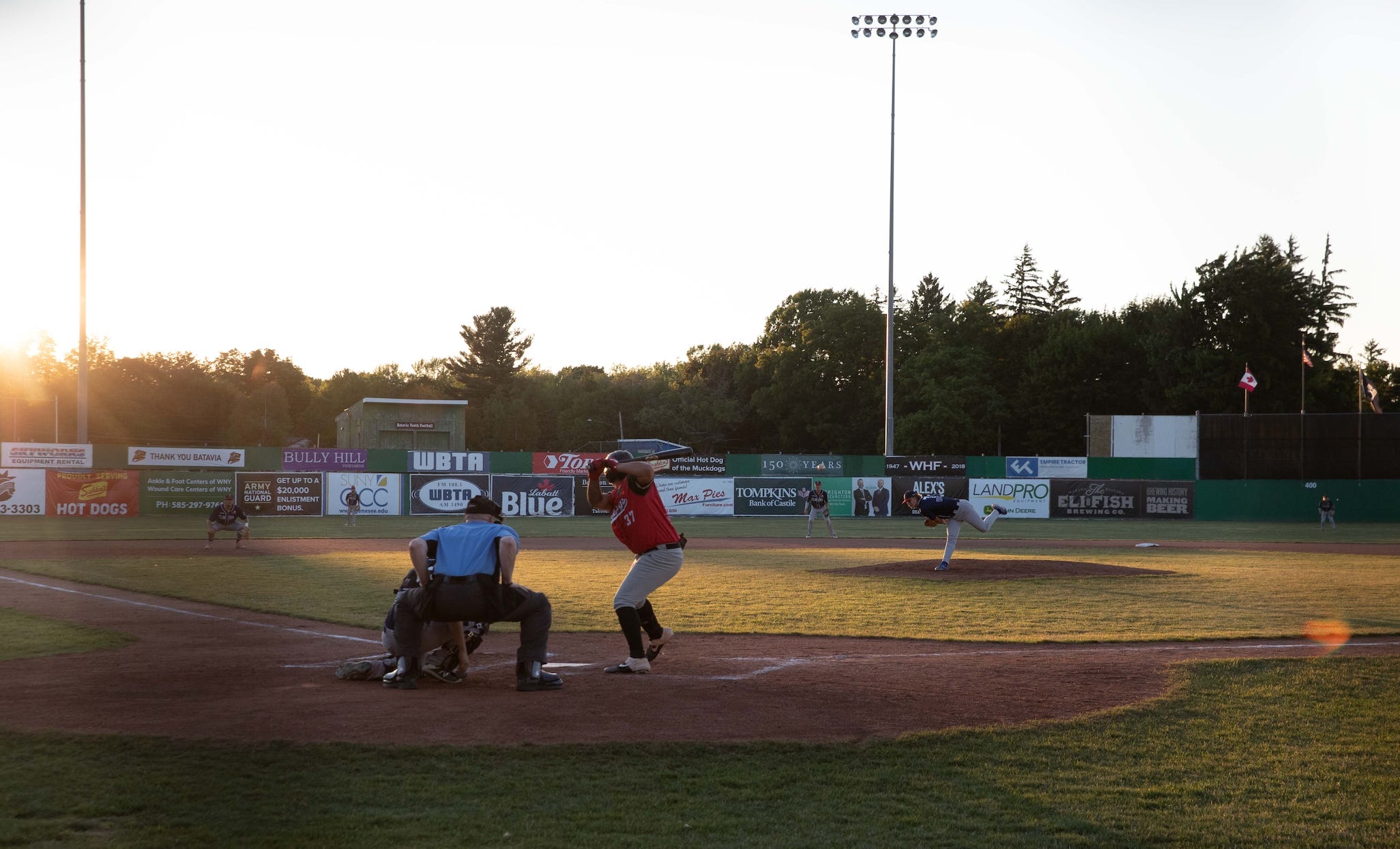
As I spent time in his company, he exuded a sense of serenity that was contagious and that I grew to appreciate. Sadly, he passed away before the book came out and never had a chance to read it. During more recent visits to Dwyer Stadium I found myself looking over to the section of the bleachers where he used to sit, half expecting to see him, and saddened by his absence. That said, if there is indeed the afterlife that he surely believed in, I don’t doubt that he sometimes joins us there in spirit.
Me: I find the trajectory of baseball a good illustration of what I call the professionalization (or corporatization) that’s dominated my lifetime, especially sports. The morphing of once smaller, more organic, more communal industries, into bigger, more efficient, and more profitable ones. McDonald’s, which I genuinely love, is another, and I could argue in the case of food, it’s been a net positive, delivering the option of inexpensive high quality products to everyone.
Yet, there have certainly been very important things lost, and I’m not blind to them, and that’s especially true in sports where the product is entertainment, but one tied to the community. What is a local team after all, but a collection of players who you support because they in theory represent your town, and while they may continually change, at least the fans stay constant, and so what the team is should be about them, and their connection to each other, and hopefully, to the players.
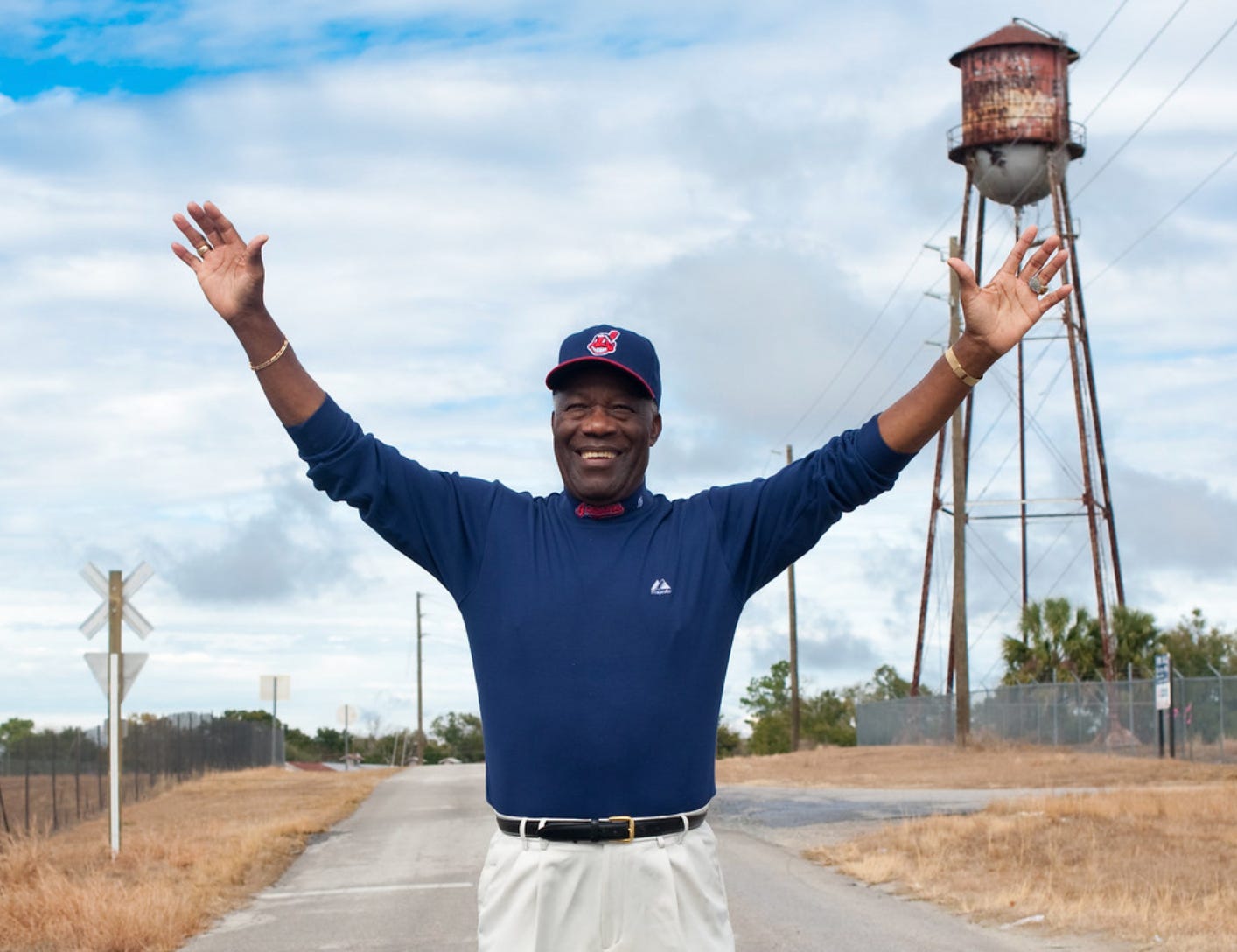
I became a Cleveland Indians fan, despite growing up in central Florida, when the closest team was the Atlanta Braves, and the only way to follow the sport was reading box scores in my weekly Sporting News subscription, because a friend of the family, James “Mudcat” Grant had played for them. He’d started in a local team, the Lacoochee Nine Devils, and worked his way up the minor leagues, and eventually made it to the World Series. His trajectory, a guy who was good at athletics, who found baseball eventually, was less immersive than what modern players require, where they are effectively groomed from childhood, weaving their way through a series of workshops, traveling-teams, summer leagues, etc, so that by nineteen, they are fantastic at baseball, already five years or more in a professional bubble.
I’m not going to deny that consequently the quality of play currently is phenomenal, better than it has ever been perhaps, but the players are now less “regular people” with a different skill, but something altogether different.
Also, the entire cost structure has changed. Put bluntly, it’s very expensive now! So when going to a game, to hang with the other fans, and hopefully interact with them in some small way, starts to cost well over a hundred dollars for a family, then you’re taking away the most important access point. And when the players become businessmen who diminish their personality to maximize their career earnings, you lose a lot of the appeal of the game, and the ability for fans to relate to them, like the players in “The Boys of Summer.”
Minor League baseball always tempered that trend, allowing access to a wider group of fans, at far less cost, and again to sound naive, I’d thought MLB would expand it, rather than contract it, because it understood that, and also still felt some obligation to be a public good. It does after all claim to be America’s pastime.
In your first answer you drew a parallel between Iraq and small-town baseball — ordinary people doing the best they can despite decisions made by distant elites over which they have no control. A move towards professionalization, which while it might be delivering a “better product”, at least by one metric, is also taking away community. Do you think that’s the defining American story of our era, and if so, what do you think it says about the health of the country that the same dynamic keeps appearing everywhere you look?
Will: You are right, we are seeing this dynamic playing out across so many industries, though for some reason putting profit maximization and creating “shareholder value” above all else - including the civic health of our communities - at least seems somewhat more palatable when you are making widgets as opposed to purporting to be “America’s Pastime” (and enjoy an anti-trust exemption in part due to this carefully cultivated identity). From everything I can see it seems like MLB has a very short-term focus on profit maximization today as opposed to acting like sincere stewards of the game with a focus on its long-term health.
And there is something alienating to me at least watching someone like Juan Soto on the hapless Mets (my team, no less!) misplay a ball, loaf after it, and then laugh off the entire episode. As if that wasn’t aggravating enough, you then remember that he earned $300,000 that afternoon for that level of effort. It just seems like a slap in the face to working families, who, like you say, just paid $50 to PARK at the stadium, before paying $50 for average seats, $15 for beers, $10 for hot dogs, etc.
Though I am pretty critical of how insulated contemporary players are from the “real world,” and the communities they represent, I would be remiss if I didn’t mention a recent example of a superstar doing something very cool here in Pittsburgh. Paul Skenes, one of the best young pitchers in the game, stopped at a local Little League diamond one evening Pirates had off and played catch with the young kids who were there for practice for over an hour. As far as anyone can tell, this wasn’t a publicity stunt but rather just a genuine spontaneous nice thing to do. Needless to say the kids – and parents – were overjoyed. My son was insanely jealous of them when I showed him the clips that had been posted to X.
That said, the fact that the entire episode instantly went viral and was a lead story the next day on ESPN shows just how unbelievably rare such organic interactions now are. Long gone are the days when it was not that uncommon for all-time greats like Roberto Clemente – also a Pirate – to stop on the way home and toss a ball with youngsters he saw playing as he drove past.
Back to your question, I would actually challenge a few of the assumptions you made. I would contend that while the sheer athleticism of baseball players today may eclipse that of players forty years ago as far as their speed, power, velocity, etc., the quality of the play and overall entertainment value of the game may not be as good. The obsession with analytics over human experience and intuition (and again, one can find parallels of this in other industries) has resulted in a game featuring lineups full of .240 hitters who either strikeout or hit an occasional homerun facing five different pitchers who appear briefly to just throw as hard as they possibly can, while fielding seems to be getting sloppier and sloppier. This does not - to my mind - result in a more appealing product.
Furthermore, I would push back a little on the assertion that businesses really are more “efficient.” I mean, look at airlines. Or almost anything involving customer service. Does having the customer wait on hold for forty-five minutes to speak to a chat bot that can’t even answer his question make things more efficient? Or does it just save the company money at the expense of jobs and customer satisfaction? Or replacing a restaurant server with a QR code that takes ten minutes to navigate through on your iPhone whereas it used to take ten seconds to place an order with an actual human being?
Similarly in baseball, eliminating the low minors and just sending top prospects to a spring training complex to run them through some tests and then have a quant wizard spit those numbers into a computer to identify the most valuable ones as opposed to having an old school scout actually watching them over the course of an entire minor league season may be cheaper, and perhaps even more efficient for the MLB club, but I am not totally convinced it is the most effective way to identify the best baseball players. And, as always seems to be the case when “efficiency” is cited as the reason for a corporate decision, this results in fewer jobs for those lower on the ladder, such as scouts, coaches, not to mention the players themselves as there are fewer minor league clubs to play for, and more money for the owners.
So yes, what I see MLB doing is what we can see happening everywhere, across industries ranging from nursing homes to health care and hospitals to hardware stores, airlines, financial institutions, publishing houses, Hollywood studios, and the list goes on. Consolidate (often after buying with debt), wipe out local ownership, homogenize operations, lose local character, cut costs, eliminate jobs, produce an inferior customer experience and product, all while making a few wealthy investors and corporate insiders even more wealthy.
All of this is to say that I am not terribly bullish on the health of our country... and this isn’t even getting into our toxic politics or the collateral damage to the labor market that the forced embrace of AI is likely to produce.
All that said, hopefully we can end on a slightly less grim note, as I hope some of your readers will be encouraged to actually read my book! And they won’t if they think it is three-hundred pages of me lamenting the state of America today.
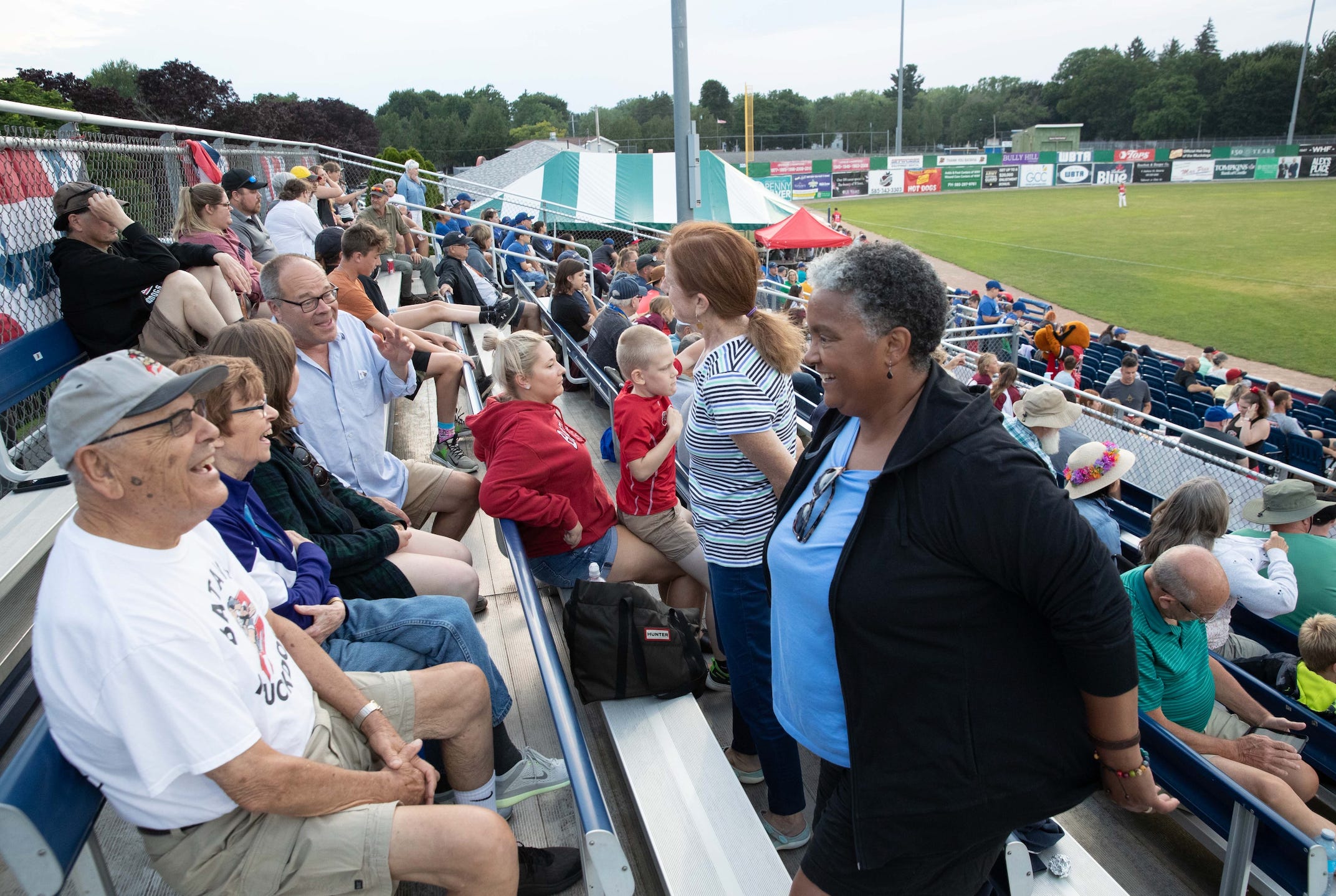
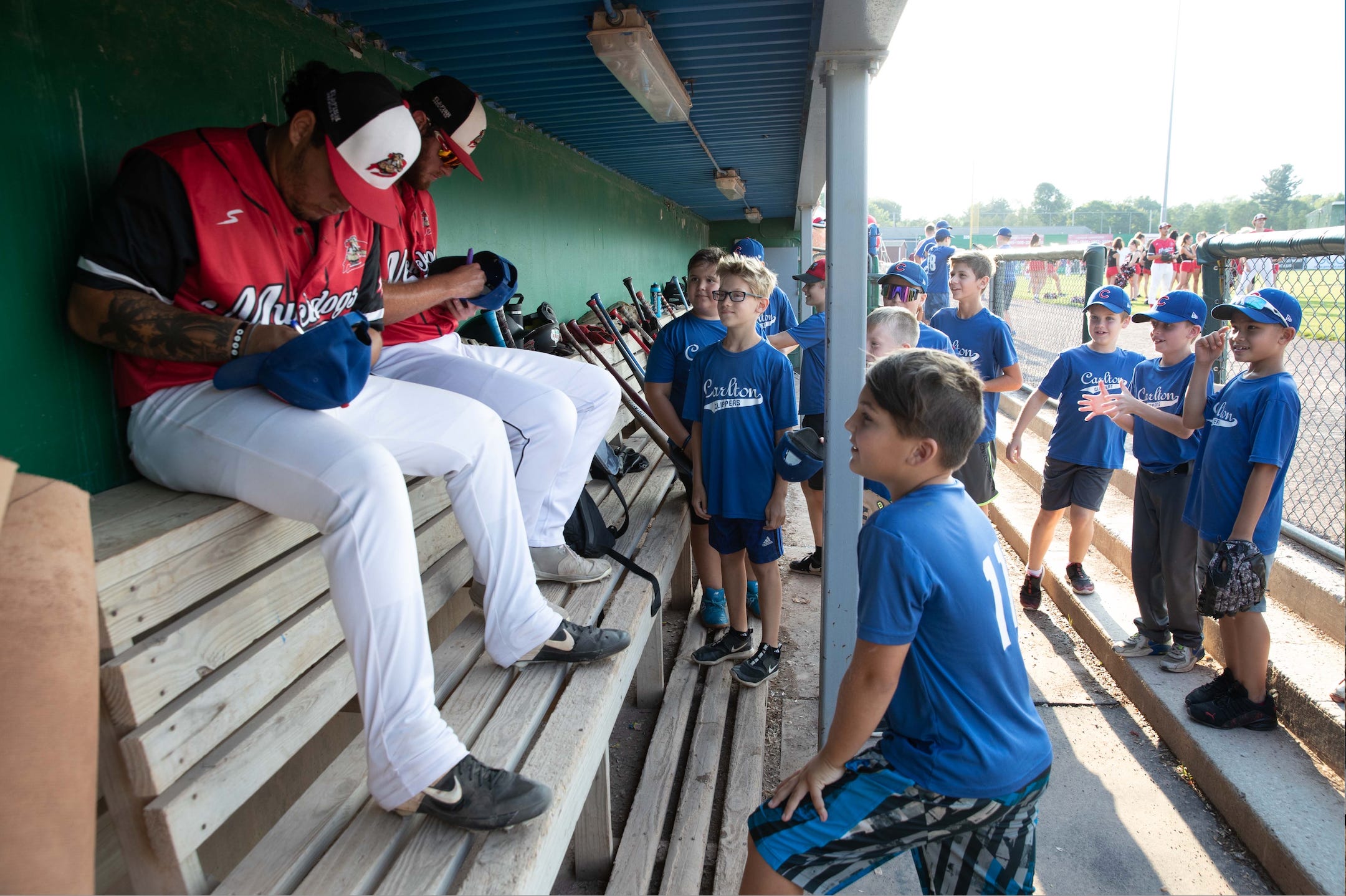
I really did try - and reader feedback has been overwhelmingly positive in this regard - to focus on communicating the happiness that these small-town teams like the Muckdogs deliver to their communities. This is perhaps even more noteworthy and important in light of the aforementioned challenges many Americans are confronting today. For a few hours at least on most nights of the summer you can find generations of fans coming together as the sun sets over towns across America like Batavia, all with smiles on their faces.
My hope is that Homestand captures some of this magic; the kids gleefully playing catch by the bullpen and hounding average college players for autographs as if they are celebrity athletes, the packs of high school boys and girls trying to act cool as they anxiously circle each other, parents spooning ice cream into the mouths of toddlers, twenty-somethings downing cold beers after work, and grandparents taking it all in with an air of serene satisfaction as they enjoy conversations that slowly unspool over the course of days and weeks in their usual bleacher seats surrounded by friends and neighbors.
Me: I agree baseball is far less entertaining now, despite having more athleticism, and I disagree (kind of) that efficiency hasn’t made other industries “better”, but I’ll end this on the positive images you have in Homestand, which while a condemnation of corporatization, I read more as a celebration of human resilience.
Kendric Tonn: Painter
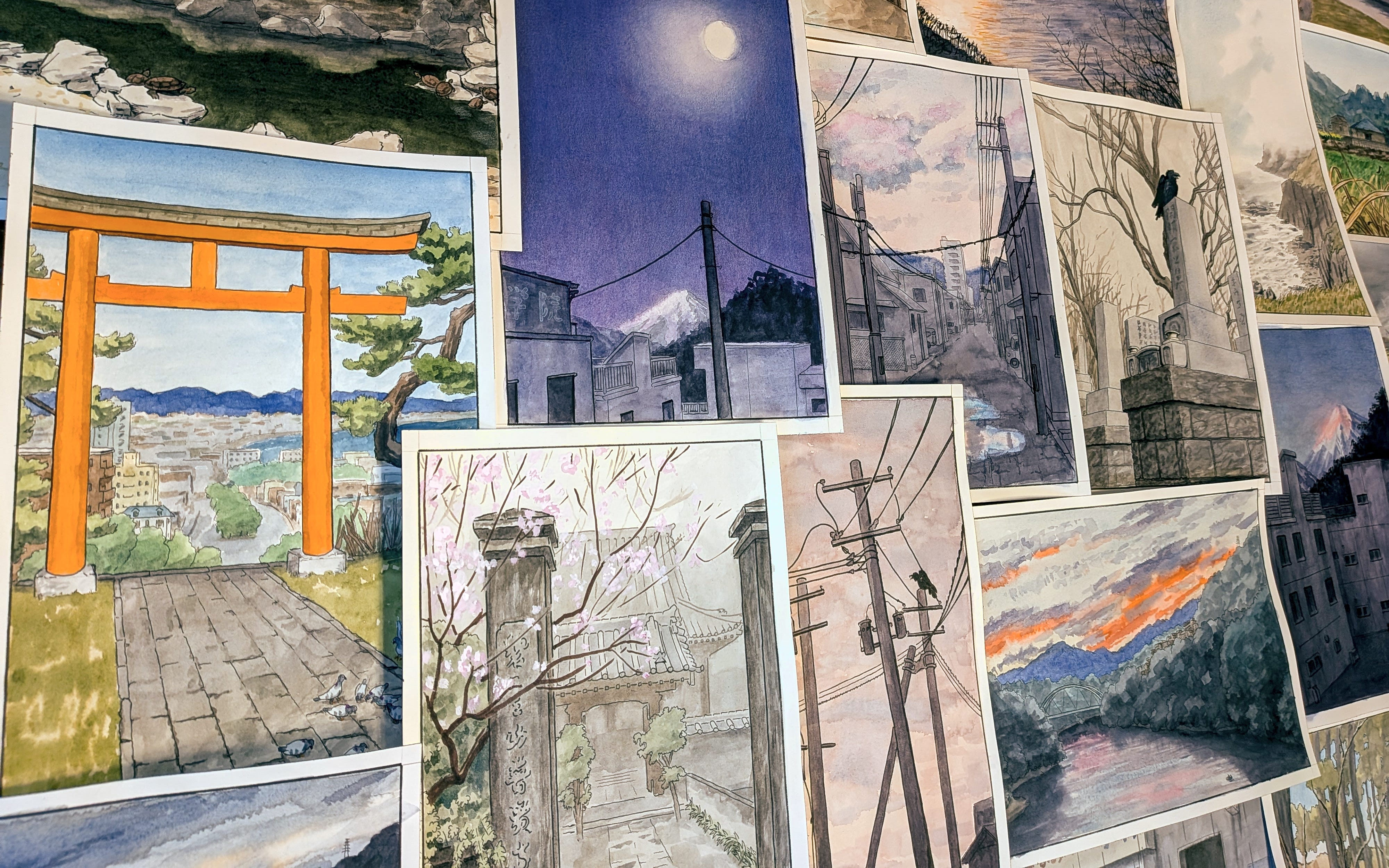
I found Kendric online, where we kept bumping into each other, usually over comments about Japan, where I found he exhibited a rare (especially for social media) thoughtfulness, modesty, and insight. He seemed to spend a lot of time there, and yet unlike many accounts, he wasn’t the Japan-bro, who constantly told people, “No, you don’t understand Japan like I do.”
I was further intrigued when I realized he made his living as an oil painter, living in Columbus Ohio. So when I passed through, we shared a coffee at McDonald’s, and in person he was more impressive than online, although equally humble.
This last October we overlapped in Kumamoto — he was working on his third book of watercolors of Japan, me doing my usual walking thing, and we spent more time together, and he was kind enough to give me copies of his two prior books. I’ve always been intrigued by how artist work, what it means to “try and capture a place”, especially in words and pictures, and I believe he’s the perfect person to talk about that. So, we chatted over email.
Me: I’ll start with the most obvious question. What drew you to painting Japan?
Kendric: Let me start with a brief introduction: I was trained as an oil painter in the Western tradition, and the core of my work is representational oils of figures, portraits, and still lifes. If you’re picturing a guy with a beret and stereotypical arm palette painting naked people in a somewhat gloomy maximalized environment, I don’t own any berets, but you’re otherwise spot-on.
For the last few years, though, I’ve been heavily engaged in a Japan-based project. The work I’m doing for that, inspired by Japanese printmakers, is primarily watercolor (properly you’d call them mixed-medium watercolors). I just returned from my third long trip there for this project, and I’m currently pulling the paintings into my third art book-slash-travelogue.
This is a question with an obvious answer, and that answer isn’t wrong, so I’ll start there. Everyone wants to paint Japan! The mountains and deep-forested valleys, the shrines and bridges, the herons in rice fields, the Ghibli-esque train lines running parallel to rough coasts where the sea splashes on dramatic boulders. The country really does look like that, and it’s certainly fertile aesthetic ground.
It doesn’t, however, all look like that. Not even remotely. So let’s return to the question of what drew me to Japan via a circuitous route: I’d been there before I started this project, actually. Once as an exchange student, and again after I graduated to take an ESL job for a year while I sorted out my early-20s crisis. I did a lot of drawing on both those trips, too (I made the decision to go back to school for art while in Japan, in fact). It left a lingering mark, and I’d always wanted to return there to paint, but it wasn’t the shrines-and-Fujis Japan that really stuck in my head. Neither was it really the Neuromancer-Blade Runner-Lain aesthetic axis, though you can find that too.
Rather: there’s a dreariness to Japanese city design, actually. Whether it’s because the whole country had to be rebuilt rapidly, or a conception of buildings and houses as a bit more consumable that we think of em, or some other factor, I don’t know, but you quite rapidly begin to learn the blocks out of which the urban environment is built: thus the houses and the drain covers; thus the stations and the konbinis; all to a relatively limited set of patterns. The places of shocking beauty we think about are mixed into a… well, a repetitive setting. And I don’t mean mere functional, like a McDonald’s, laundromat, and gas station by the side of the highway.
And yet, it’s not entirely unpleasant. It can be dreary, but the repetitiveness can also be uncanny: you can feel unmoored in time and space. And that sort of vibe is really what stuck in my head over the years between leaving Japan and returning there as a professional artist! It’s not the only thing I go there to paint–I am very happy to paint the Fujis and the temples too–but I’ve tried, across the body of work, to catch a little of those two sides, and how it felt to walk through them.
Me: That dreariness, or even an ugliness, is something I’ve written about and photographed. I remember on one particularly long walk — out of one large town, through the rice-fields, to the next large town that looked like where I’d started, I felt as if I was going a little mad, and began to obsess about how boxy everything was, and I even shouted out, to nobody, “Give me a curve, any curve. My kingdom for a curve!”
Yet, like you, I keep coming back, because despite those periodic moments of claustrophobic insanity, there’s so much beauty there — not only in the nature, but in the calming familiarity. Then there are the easter eggs you find, the ubiquitous vending machine adjacent to a Shinto shrine, or the paper mill (clean, orderly, and almost regal, despite belching sour smoke) with a well-tended rice field as one border, a boxy apartment building another, a 7-eleven another, and lastly, a field of parked bikes, presumably for the workers.
When we overlapped in Kumamoto, we both went on long seemingly aimless walks, separately, but both with the intention to find “images”, me to photograph, or write about, you to paint. Given your medium is much more selective, requiring a few days at least per image, I’m curious how you decide what to paint. I realize that’s almost an impossible question, but perhaps you could give it a go by highlighting two of the paintings from Kumamoto, and say why you chose those?
Kendric: The destination feeling like the starting point is so real. I feel it most in Tokyo–something about the Tokyo way of having multiple distributed urban centers. You get on a train, viscerally feel yourself travelling for an hour or two, and then when you get off at your destination you think, huh, this feels like a lightly-remixed version of where I began.
As far as subjects and methods go, though, we operate in somewhat similar ways, I think, though while you cover ground more linearly–you’re actually travelling!--I tend to loop and loop and wander back through familiar territory. I try to get a gauge on what a place is like, internalize the essentials, and sometimes seeing the same thing in different conditions can make something stand out. Here’s one piece that I did late in my stay in Kumamoto that was, maybe, a thousand feet from my apartment:
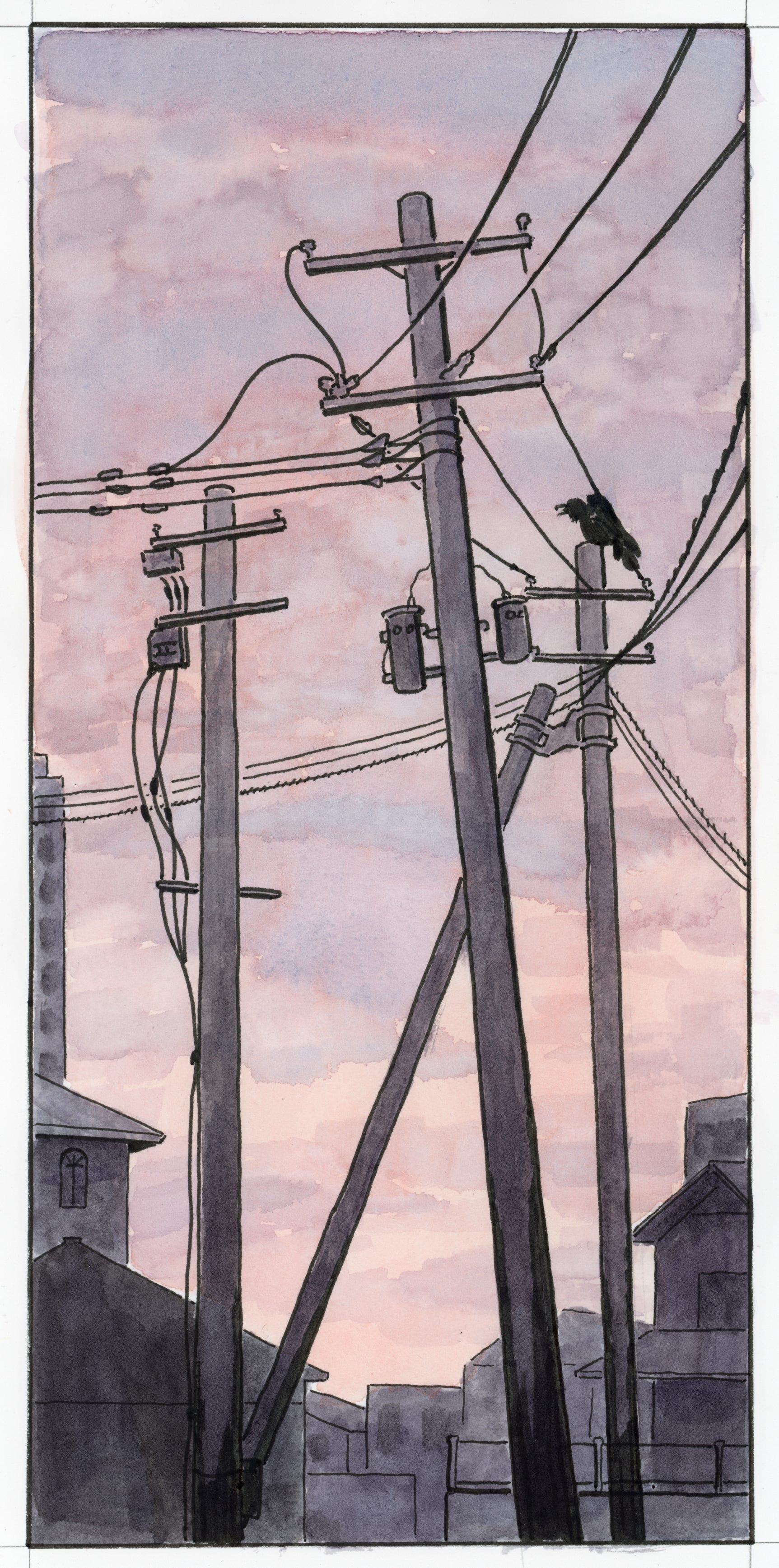
I’d had the vague idea I wanted to do something with utility poles and wires–they’re such a dominant element of the way they build, even relative to us in the US–but although I’d walked past this grouping of three poles probably thirty times or more by then, it wasn’t until I happened by while the sun was setting and a crow was being noisy nearby that I thought, ah, there’s the composition.
Or similarly, this piece here, which again was quite near where I was staying in Hakodate:
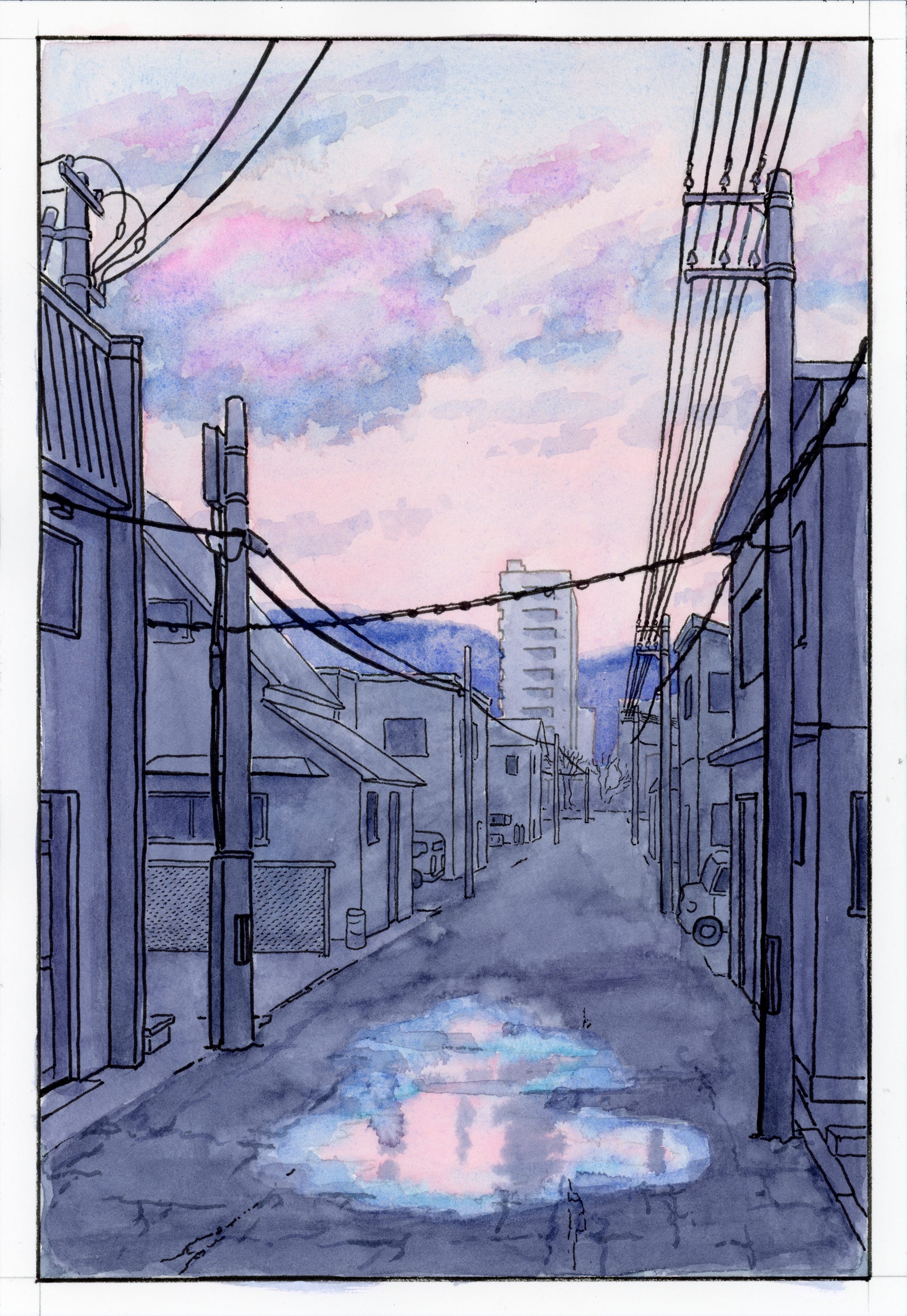
I’d known I wanted to do a long shot of an unprepossessing street. You walk down a thousand streets that look pretty much just like this, and it’s an important subject in that it’s a huge part of the feel of wandering around Japan. I hadn’t been able to find one I quite wanted to do, though. Then I’m going along one evening–you know, I’ve just realized that both of these pieces started with an excursion to a convenience store for candy–and, bam, there’s the puddle in the road. It opens up the scene a little, gives a window and some interest. But again, it’s a place I’d walked past several times without noticing anything.
Me: I see you doing what I’ve labeled Thick Travel, spending enough time in a place to be confronted with the mundane, and hence see things essential to a place that can be lost in a mad rush to see the spectacles.
But you, and me as well, are also never fully a local. We remain permanently a visitor, which gives us a kind of double vision, always the outsider, but with enough familiarity to see things others might not. Do you think that in-between state, neither tourist nor resident, is actually the most productive place to work from?
Kendric: I do feel like–to put it romantically–loving something from a distance can be a fertile condition to work in. Artists probably should be outsiders in a way, don’t you think? I don’t mind political movies, but I don’t much care for them when the director or screenwriters are “inside” the politics, so to speak. There’s a state of engaged detachment that I think produces the most honest work, and that’s also true depicting a place, be it in words or photos or paint. You have to engage with it, which takes time and effort, but a job in Tokyo, a Japanese girlfriend, a tight crew at the local izakaya–whatever–aren’t the kind of engagement you need.
Me: I definitely believe that in-between state of neither fully an outsider, or insider, has clear advantages for artist, and writers. You have the ability to see “the water everyone swims in” that sometimes locals don’t recognize, because it’s so normal, since it is unfamiliar to you, as well as the things missed by tourist, the odd things wedged away from the must-see sights. Of course every perspective comes with minuses, and it would be absurd to ever claim you fully understand a place. For that, you need a mix of perspectives, obviously including from life-long residents.
To those ends, I’ve noticed, when in Japan, you seem to live a rather monastic life when in Japan, and rather in indulging in its food, drink, and nightlife, choose the sparse. In one instance, you stayed in a tiny seaside village for an extended period, that from your accounts, and paintings, seems to be literally disappearing back into the earth, slowly, one aging residents death at a time. The closest convenience store was an hour (am I wrong) bus ride away, and you had no car. I’m fascinated by that, and would love to hear more about the experience, and how it shaped your understanding of Japan.
Kendric: Before I went on the first trip, I thought, you know, I’ll have some fun too. I’ll go out, have drinks, whatever. I absolutely did not, not on any of the trips. Monastic is absolutely the word. Kind of as earlier, I’m there as a thickly embedded yet highly detached observer, and I never even found I wanted to exit that mode, really.
That’s a pretty accurate description of a place I spent a month on trip two, Iinoura in Shimane Prefecture, yeah. And of a lot of places in Japan. It’s something I’m lucky to have had the chance to see. Villages like that are, of course, dying all over the country. I suspect Japan as a whole will be fine, and honestly I think they may deal better with their demographic contraction than a whole lot of other places are going to, but that said, I suspect a lot of life and lifestyle that existed in little places like that will be washed away. The village goes, the people regroup towards Tokyo. Eventually people probably go back out: someone with a starlink connection, autonomous car, and three robot servants thinks, hey, building my new place out in half-forgotten village X sounds like the move. But it won’t be the same, eh? Nothing ever is.
Don’t let me overstate it, though: again, it’s not like I was going to village festivals. It’s not like the handful of sweet ninety year old women who would bow and say good morning while looking bemused at my presence were probably putting any on. The shrine looked unvisited; I was the only one getting on or off the one-car train that stopped like three times a day; the boats moored at the fishing collective were unmoved and the collective itself sure didn’t look to be having much happening either. They were taking down abandoned houses while I was there. I just got to see a brief impression of the place.
Me: One of the things I appreciate about your books are the short essays that accompany each painting. I became a writer because I felt that the cliche, “A picture is worth a thousand words” wasn’t applicable. Sure a picture says a lot, but you can’t say everything with it and so I began to add larger and larger descriptions to my photos, and soon the writing became primary, the photos secondary. Painting is a different medium, and a more expressive, but you still add text. I’m curious how you view that balance? I liked your writing enough I often wanted to hear more from you!
Kendric: I found something similar! I think I’m, in a sense, doing two different kinds of art on these trips. There are the paintings, each one (I hope) standing up as a self-contained thing, an image that makes its own aesthetic statement. And then there are the books, which I’ve sometimes called a painted travelogue. I don’t want to go into a lengthy blow-by-blow of every train change and meal like some travel writing does, but I’m hoping to convey some feeling to the reader-viewer of what it’s like: to be this specific person, doing this specific thing, in these specific places.
I briefly had, and sensibly discarded, the idea of writing a haiku for each painting. If I ever descend that far into cliche please beat me with a stick, a stout one. But that said, I kept the ghost of the concept: the short length and visual appearance of the short prose sections that accompany each painting, and sometimes their emphasis on passing experiential effects, are meant slightly to recall that idea.
Me: First of all, thank you for your time, and the wonderful books. I hope all my readers buy them. They make great gifts! Before we end though, since this is after-all a travel newsletter, a few simply questions. You’ve now done three extended painting trips to the country, so give us a few quick takes, with single sentence answers.
What is your favorite city in Japan, where you would live for a year if you had to?
Kendric: I really liked my two weeks in Kamakura and the Shonan Coast, but honestly, I’d spend a year where I did spend a year teaching ESL just after college: somewhere in Chiba, convenient to everything but not as crushingly busy as Tokyo proper.
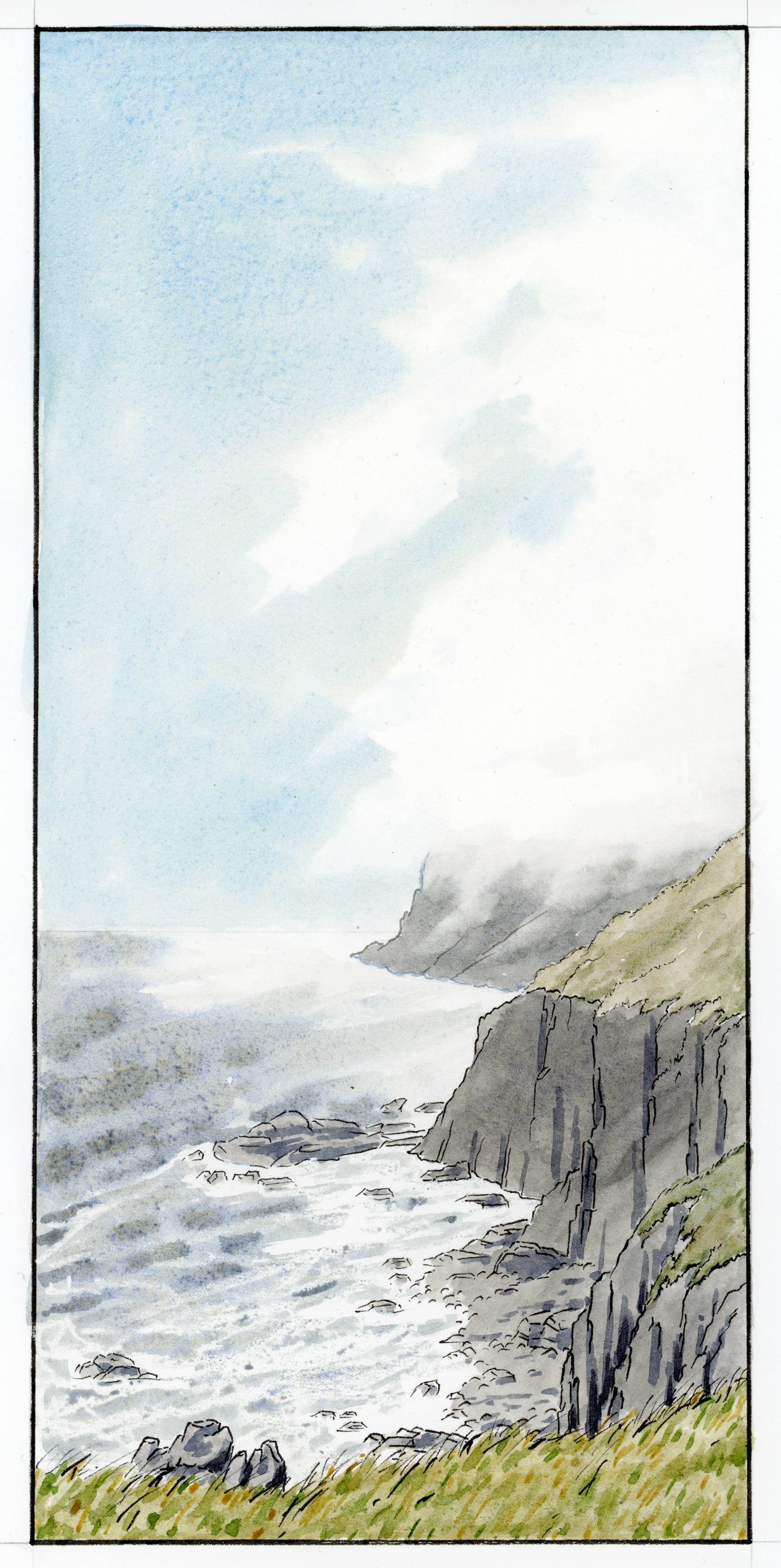
Me: What image of yours (I know this is like choosing your favorite child), sticks with you, that gun to your head, you would pick.
Kendric: Sneak preview from book three! I suspect this might be more of a “painter’s painting”, as it were–it’s not flashy or high-saturation–but I felt good about this one.
Me: What three “tips” would you give a first time visitor to Japan, logistical, or other, to give them a more meaningful, and fun, experience?
Kendric: Get out of Tokyo and Kyoto. No shade to either, I’m not saying don’t go, but… get out of Tokyo and Kyoto. Or generalizing, man, you don’t need to do the Standard Itinerary, you know?
I’m a big believer–I suspect you won’t be hostile to this idea–in walking. If you’re going from station A to station B, consider an off-the-main-arteries walk; that’s where the interesting incidents seem to happen.
My personal tip number three is “have a self-directed project you carry with you that’s intimately linked to being where you are.” I’m not sure if that’s exactly universally actionable, although it’s what I’ve always relied on.
Me: Where can people buy your books?
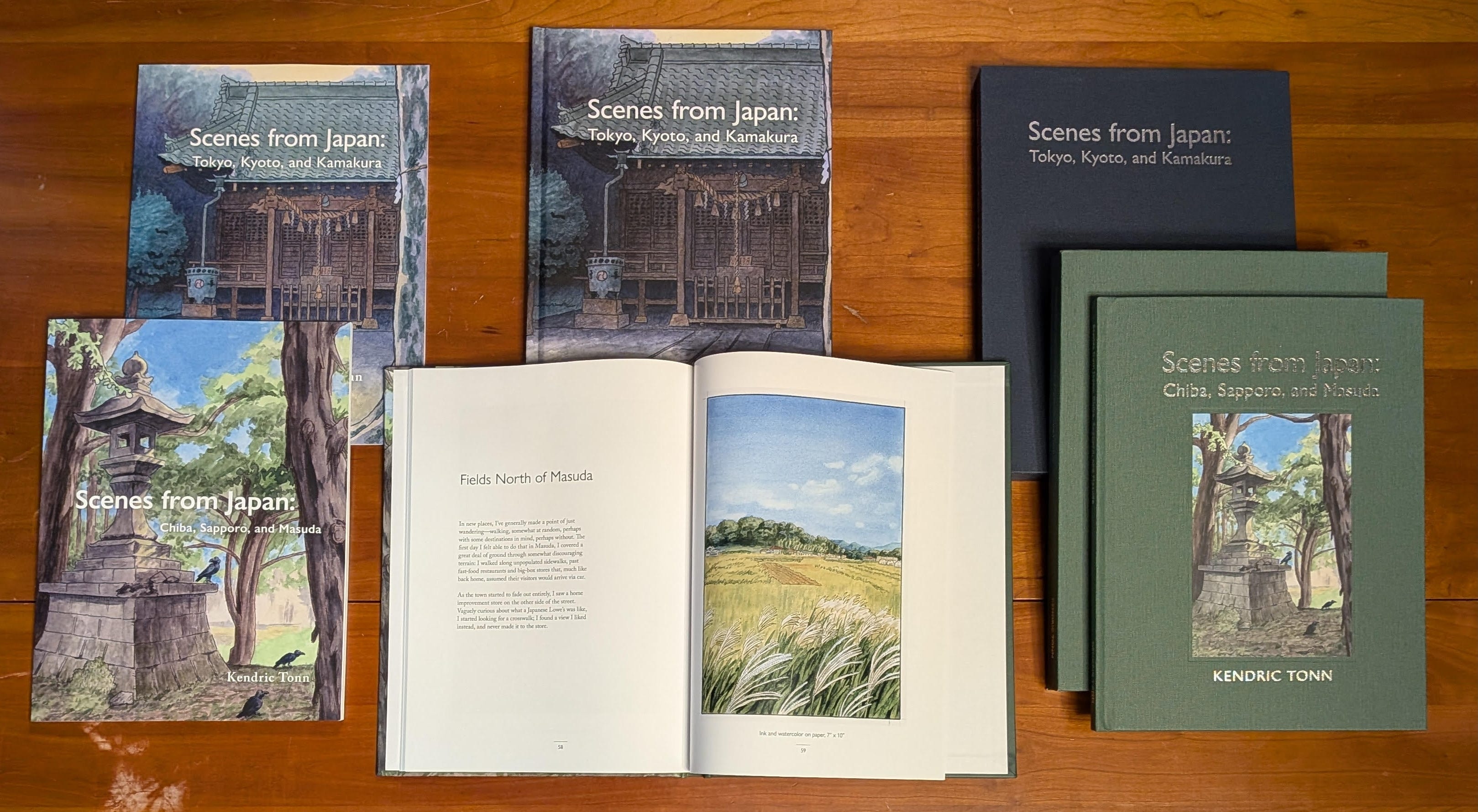
Kendric: We’ve talked a bit about the books. They’ve been a huge component of this whole Japan project, but they weren’t initially part of the plan. I’d only intended to go, paint, and bring back the pieces, more or less in the same way I always work. I ended up doing a much larger body of work on the first trip than I’d expected, though, so some friends pushed me to collect the pieces in a book. I did a Kickstarter which went quite well, well enough that I returned for a second painting trip and a second book. And two books together didn’t look quite right, so I decided to go one more time to round out the trilogy. That Kickstarter is currently ongoing, in fact, and I hope to deliver the third book very soon!
Moby Dick Book Group!
Reminder, the book group call will be July 14th (Tuesday) at 7 pm, and July 15th (Wednesdy) at 12 pm noon -- both NYC time.
I would like to limit it to no more than twenty per zoom call, so everyone has a chance to talk, so if you can make the Thursday afternoon, please do that, since most of you are in the US.
If I get more interest, I’ll add a third and later date, until then, lets go with these two.
Below is the links for the calls. All I ask is everyone come to the call with a book at your side so we can reference excerpts if necessary, and to have read it, or at least re-skimmed it if you not read it in awhile.
I’ll do minimal moderation, hoping the discussion can go in a more organic direction. For those who have not already read it, here is my own review: Reading Moby Dick
I’ve found it helps me to write a short essay before joining a book group, to gather your thoughts, although that certainly isn’t a requirement.
Regardless, enjoy the book, if you haven’t already finished, and see you then!
Below are the two links for the zoom calls:
Topic: Moby Dick Book Group
Time: Jul 14, 07:00 PM Eastern Time
https://us06web.zoom.us/j/86144267042?pwd=yti3vmdeGl3TjnyzGjF3UsxkDfiNaK.1
Meeting ID: 861 4426 7042
Passcode: 053337
------------
Time: Jul 15, 12:00 PM Eastern Time
https://us06web.zoom.us/j/82870471111?pwd=spKqz2yGH1xQ8iID4HESKwQMWNzjft.1
Meeting ID: 828 7047 1111
Passcode: 866887
PS: After a brief stop-over in Chicago, I’ll be spending all of August in Australia. I have a ambitious agenda, and we will see how much of it I achieve, but right now I’ll be making my way from Perth, to Sydney, via Broome and Darwin (and many additional stops), by bus. As always, if you happen to be along my route, especially in Newman (lol), please reach out.
All writers, photographers, and journalists do some form of this, including myself. We harvest stories, photographs, and experiences, and then put them out into the market, to be consumed. The question becomes then, at what pace do we do it, for what purpose, and who is the focus? Even those who sit alone, writing essays on their solitary thoughts, although they have the advantage of believing they owe little to anyone else but themselves, they have the disadvantage of a narrowness of perspective, limited to their ego.
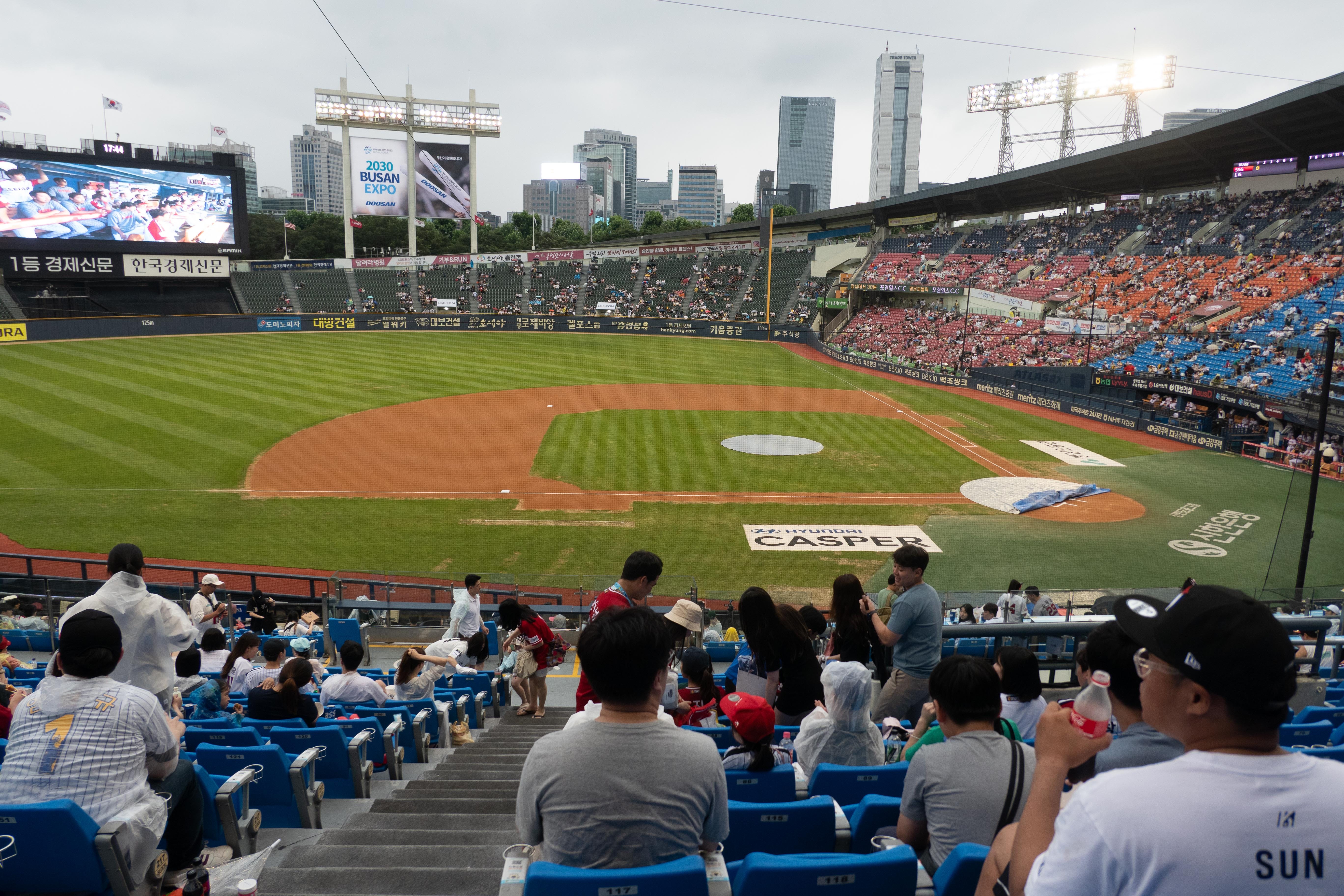
The cover photo is from a baseball game in Korea, not Japan, but it is the best image I could find that comes close to capturing the two different interviews.
Baseball in the minors and collegiate leagues is a blast. Totally different from MLB or even AAA. No replays, no ABS challenges. Accessible players, sour note National Anthems, windshield shattering foul balls and a certain goofy feel to the whole enterprise. Like the drunk UMP who got sent home by the fans, only to be replaced by the rent-a-cop unlucky enough to get too close to the event.
But every once in a while, baseball magic happens. The bunt that becomes an in-the-park homer because of compounded throwing errors. The pitcher that loads the bases with three successive hit batters then fans the next three for a scoreless inning.
If you're a patient fan, tears of joy and wonder will happen.
Fantastic interviews, both were a delight to read :)